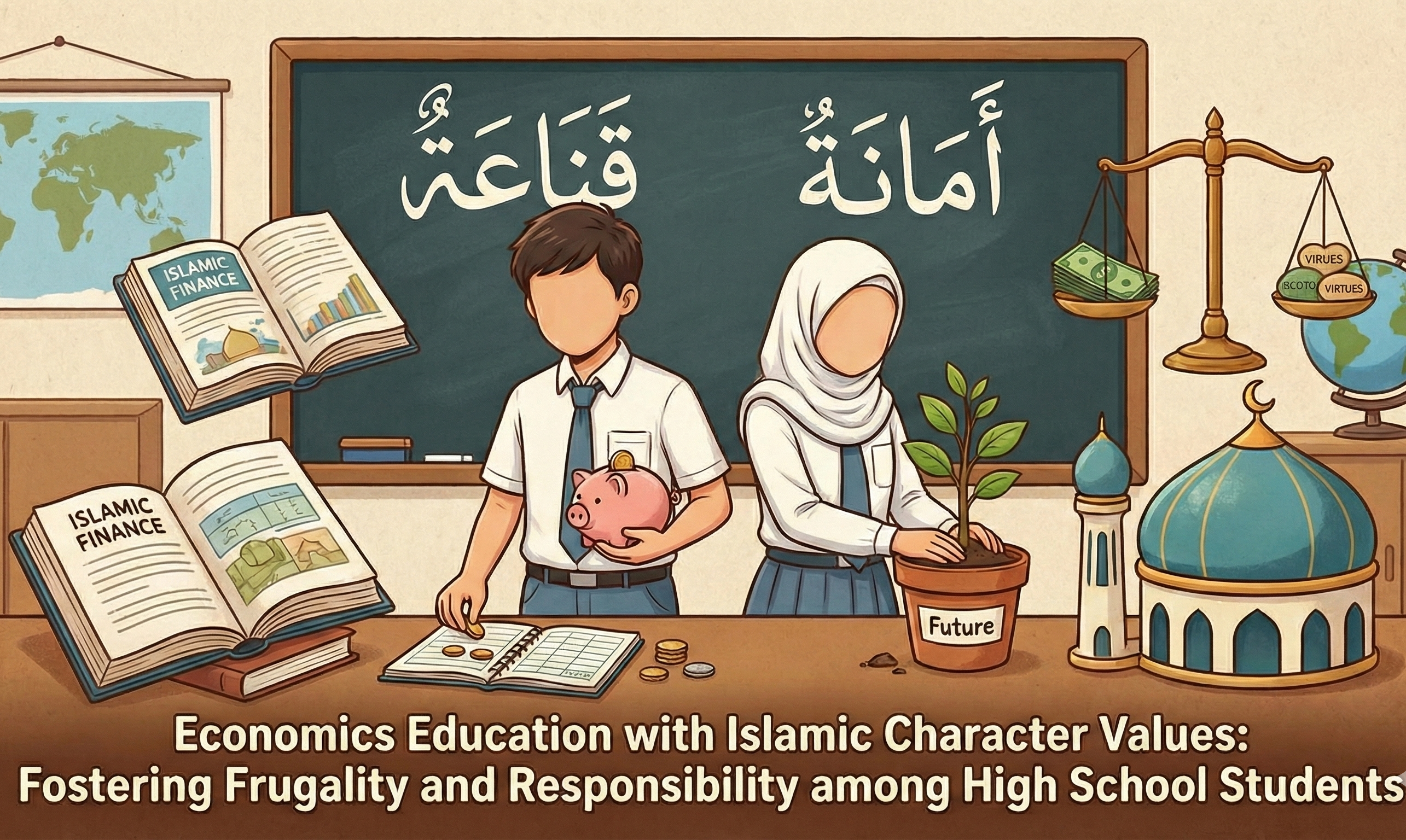
Economics Education with Islamic Character Values: Fostering Frugality and Responsibility among High School Students
DOI:
https://doi.org/10.70294/rj37gx39Keywords:
Economics learning, Character education, Frugality, Islamic educationAbstract
This study aims to describe the implementation of economics learning at SMA Muhammadiyah Mlati and its impact on shaping students’ frugal behavior. The research employed a qualitative approach and was conducted August 2025, involving the principal, vice principal for curriculum affairs, economics teacher, and tenth-grade students as subjects. Primary data were obtained through observation, interviews, and documentation, while secondary data were derived from supporting documents and photographs. Data analysis followed the Miles and Huberman model, which includes the stages of data collection, reduction, presentation, and conclusion drawing. The findings reveal that economics learning was designed contextually by linking theory to real-life practices and employing interactive and motivational methods to address time constraints and student boredom. The impact of this learning process is evident in the improvement of students’ understanding of economic concepts and their application in daily life, such as saving, budgeting, and avoiding consumptive behavior. Therefore, economics learning at SMA Muhammadiyah Mlati not only enhances academic competence but also fosters Islamic character values of frugality, discipline, and responsibility.
Downloads
References
Apriwulan, H. F., Hanama, A., Pisriwati, S. A., & Siswanto, D. H. (2025). Library service management as an effort to cultivate students’ reading interest in improving activities and learning outcomes. Curricula: Journal of Curriculum Development, 4(1), 199–214. https://doi.org/10.17509/curricula.v4i1.76911
Courtney, M., Karakus, M., Ersozlu, Z., & Nurumov, K. (2022). The influence of ict use and related attitudes on students’ math and science performance: multilevel analyses of the last decade’s pisa surveys. Large-Scale Assessments in Education, 10(1), 1–26. https://doi.org/10.1186/s40536-022-00128-6
Dolapcioglu, S., & Doğanay, A. (2022). Development of critical thinking in mathematics classes via authentic learning: An action research. International Journal of Mathematical Education in Science and Technology, 53(6), 1363–1386. https://doi.org/10.1080/0020739X.2020.1819573
Hanama, A., & Siswanto, D. H. (2025). Art in the Muhammadiyah Islamic View: A Balance of Aesthetics and Ethics. Asian Journal of Philosophy and Religion (AJPR), 4(1), 47–60. https://doi.org/10.55927/ajpr.v4i1.13114
Harahap, A. S., Rambe, M. Y., Sadiyah, K., Pulungan, T. N., & Siswanto, D. H. (2025). Developing Financial Literacy and Investment Awareness to Promote Healthy Financial Behavior among High School Students. Jurnal Pengabdian Masyarakat Bestari (JPMB), 4(6), 459–468. https://doi.org/10.55927/jpmb.v4i6.180
Heryuriani, B., Efendi, R., Rambe, M. Y., & Siswanto, D. H. (2025). Fostering Academic Self-Efficacy in Adolescents: A Case Study of Counseling Strategies in Secondary Schools. JUPERAN: Jurnal Penedidikan Dan Pembelajaran, 04(02), 667–675.
Kintoko, Siswanto, D. H., Pamungkas, M. D., & Aisyah, A. K. (2025). Analysis of students’ mathematical literacy skills on the Pythagorean Theorem in Junior High School. JOELI: Journal of Educational and Learning Innovation, 1(3), 180–190. https://doi.org/10.72204/j6t4a573
Mala, R., Surya, P., & Soswanto, D. H. (2025). Managing Character Education for Students with Special Needs: A Framework of Planning, Organizing, Implementation and Evaluation. ITQAN: Jurnal Ilmu-Ilmu Kependidikan, 16(1), 65–76.
Miles, M. B., & Huberman, A. M. (1994). Qualitative Data Analysis: An Expanded Sourcebook. In Qualitative Data Analysis: An Expanded Sourcebook (pp. 1–318).
Naufal, N., Apriani, F., Fajriana, Nurdin, Nurdin, K., & Siswanto, D. H. (2025). Analisis Multivariat. Padang: Literasi Langsung Terbit.
Pisriwati, S. A., Siswanto, D. H., & Yogyanto, N. (2025). Innovating aromatherapy candles from used cooking oil for student entrepreneurship. Dedicated: Journal of Community Services (Pengabdian Kepada Masyarakat), 3(1), 1–14.
Sadiyah, K., Setiawan, A., Siswanto, D. H., & Fitriyani. (2025). Self-efficacy, learning styles, and learning discipline as predictors of mathematics achievement among vocational school students. Jurnal Ilmiah Multidisiplin Ilmu, 2(3), 138–148. https://doi.org/10.69714/40sjf608
Saleh, F., Manalu, E. O., Amrizal, Nugroho, D. H., Pujowati, M., Siswanto, D. H., Rosnelli, Septikasari, D., Radhiyani, F., Rizku, A. I., Sabandar, V. F., & Tarso. (2025). Kurikulum dan Pengembangan Kurikulum. Padang: Literasi Langsung Terbit.
Seraj, A. H. A., Alzain, E., & Alshebami, A. S. (2022). The roles of financial literacy and overconfidence in investment decisions in Saudi Arabia. Frontiers in Psychology, 13(September), 1–12. https://doi.org/10.3389/fpsyg.2022.1005075
Siswanto, D. H., Kintoko, & Astiwi, W. (2025). Implementation of Management Information Systems to Improve Educational Quality in Secondary Schools. JALADUPA: Journal of Religion Studies and Humanities, 1(1), 1–14.
Suryani, E. A., Pisriwati, S. A., Siswanto, D. H., & Syah, A. B. P. D. A. F. (2024). Pelatihan Assembler Edu: Meningkatkan Keterampilan Guru pada Pembelajaran Berbasis Proyek. Jurnal Pengabdian Fakultas Ekonomi Dan Bisnis Pancasakti, 1(1), 7–16.
Tarso, Suryatama, H., Saputra, S. A., Hanama, A., & Siswanto, D. H. (2024). Unlocking potential with entrepreneurship training for vocational high school students. JSCD: Journal of Social and Community Development, 1(02), 85–94. https://doi.org/10.56741/jscd.v1i02.737
Thierry, K., Vincent, R., Norris, K., & Dawson, O. (2022). Improving School Readiness for a Social Emotional Learning Curriculum: Case Study of a School-Mental Health Agency Partnership. Journal of Research in Childhood Education, 36(3), 483–505. https://doi.org/10.1080/02568543.2021.1960938
Thurston, A., Roseth, C., Chiang, T. H., Burns, V., & Topping, K. J. (2020). The influence of social relationships on outcomes in mathematics when using peer tutoring in elementary school. International Journal of Educational Research Open, 1(June), 100004. https://doi.org/10.1016/j.ijedro.2020.100004
Widyastuti, R., Siswanto, D. H., Pisriwati, S. A., & Alam, S. R. (2024). Optimizing organizational structure in the Muhammadiyah Student Association at Senior High Schools. Journal of Social and Community Development (JSCD), 1(02), 54–64. https://doi.org/10.56741/jscd.v1i02.672
Wulandari, Y., Rustan, S., & Dodi, I. (2024). Unleashing student creativity : A dynamic look at Merdeka Belajar Curriculum’s impact. IJAE: International Journal of Asian Education, 5(1), 21–33.
Yasin, H., & Mokhtar, M. (2022). Practices of accountability and transparency in financial management among secondary school principals. International Journal of Academic Research in Business and Social Sciences, 12(9), 198–216.