Religiouns Moderation Through Teaching And Learning Activities At The TPQ Madrasatul Qur’an Kalicinta Village North Lampung
DOI:
https://doi.org/10.70294/rvgynt68Keywords:
religious moderation, character education, community service,, tolerance, TPQAbstract
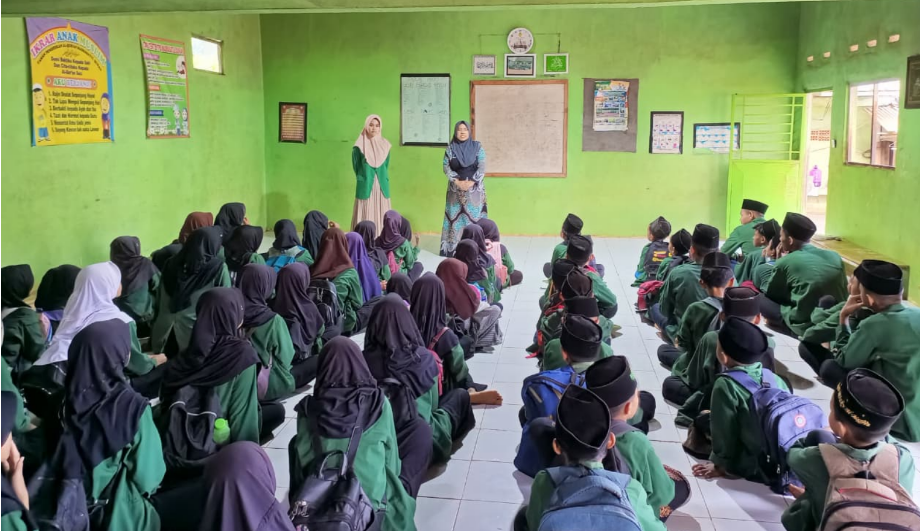
Al-Qur'an Education Parks (TPQ) are non-formal educational institutions that play a significant role in shaping children's character and morals from an early age. However, the majority of TPQs still focus primarily on reading and memorizing the Quran, while instilling the values of religious moderation has not been optimally implemented. The main challenge is how to internalize an understanding of religious moderation among students so that they can grow into a tolerant, peace-loving, and respectful generation. This community service activity aims to contribute to creating social harmony by teaching religious moderation from a young age. TPQ Madrasatul Qur'an was chosen as the target Islamic elementary education institution for this activity, with an emphasis on strengthening the values of tolerance, justice, and balance. This community service activity aims to disseminate an understanding of religious moderation within the TPQ through interactive methods, including storytelling, informal discussions, good moral habits, and simple social activities. The results of this activity indicate that the students experienced an increase in their understanding of moderation, cooperation, and the habit of respecting differences. The method applied in the community service program was Participatory Action Research (PAR). In this method, ustadzah (preachers), ustadzah (male and female), and children actively participated in guidance and educational activities appropriate to their context. Data collection was carried out through observation, recording, and direct participation that occurred during religious guidance and development at the TPQ Madrasatul Qur'an. The findings obtained illustrate that learning strategies that focus on the values of religious moderation are able to strengthen children's religious understanding in a fair and non-discriminatory manner. This program also succeeded in increasing understanding and love for the nation and state, in addition to a critical response to radical teachings with the principle of anti-violence committed in the name of religion. It is hoped that the habituation of these values from childhood can become a strong foundation for creating a harmonious, just society with a national perspective.
Downloads
References
Anwar, R. N. (2021). Penanaman Nilai-Nilai Islam Moderat pada Anak Usia Dini dalam Keluarga sebagai Upaya Menangkal Radikalisme. Al Fitrah: Journal of Early Childhood Islamic Education, 4(2), 155–163. https://doi.org/10.29300/alfitrah.v4i2.3883
Arifin, M. J., Sugiono, I. B., & Hakim, A. R. (2021). Pengembangan Taman Baca Sebagai Upaya Meningkatkan Literasi Anak Bangsa dalam Bingkai Moderasi Beragama. Abdimas Indonesian Journal,1(1),1-17. Retrieved from. http://journal.civiliza.org/index.php/aij/article/view/68
Asrori, S. (2020). Lanskap Moderasi Keagamaan Santri, Refleksi Pola Pendidikan Pesantren Jurnal Ilmu Sosial Indonesia, 1(1), 16–26. https://doi.org/10.15408/jisi.v1i1.17110
Fauzi, A., Lestari, P., & Maulana, D. (2020). Kolaborasi Ustadz dan Orang Tua dalam Menanamkan Moderasi Beragama. Jurnal Pendidikan Nonformal, 12(1), 66–79.
Hermawan, A. (2020). Nilai moderasi Islam dan internalisasinya di sekolah. INSANIA:Jurnal Pemikiran Alternatif Kependidikan, 25(1), 31–43. https://doi.org/10.24090/insania.v25i1.3365
Hidayat, R., & Amalia, F. (2021). Penguatan Nilai Moderasi Beragama melalui Kegiatan Sosial di TPQ. Jurnal Abdimas, 5(2), 44–58.
Hilmy, M. (2013). Whither Indonesia’s Islamic Moderatism? A Reexamination on the Moderate Vision of Muhammadiyah and NU. JIIS: Journal of Indonesian Islam, 7(1), 24–48. https://doi.org/JIIS.2013.7.1.24-48
Islam, T., & Khatun, A. (2015). “Islamic Moderation” in Perspectives: A Comparison Between Oriental And Occidental Scholarships. International Journal of Nusantara Islam, 3(2), 69–78. https://doi.org/10.15575/ijni.v3i2.1414
Ismawati, D. (2014). Upaya Guru Dalam Menanamkan Nilai-nilai Pendidikan Agama Islam Melalui Ekstra Kulikuler Karawitan di Sekolah Dasar Muhammadiyah Purbayan Kota Gede Yogyakarta (UIN Sunan Kalijaga). Retrieved from.
Kementrian Agama RI. (2019). Buku Moderasi Beragama. Jakarta: Kemenag RI.
Kementrian Agama RI. (2024). Peraturan Mentri Agama No. 3 Tahun 2024 tentang tata cara koordinasi, Pemantauan, Evaluasi, dan Pelaporan Penyelenggara Penguatan Moderasi Beragama.
Masnawati, E., & Fitria, S. N. (2024). Peran TPQ dalam Pengembangan Akhlak Anak. Irsyaduna, 4(2), 213- 224.
Mardliyah, A. A., & Rozi, S. (2019). Karakter Anak Muslim Moderat; Deskripsi, Ciri-Ciri dan Pengembangannya di Lembaga Pendidikan Anak Usia Dini. TARBIYA ISLAMIA: Jurnal Pendidikan Dan Keislaman, 8(2), 231–246. https://doi.org/10.36815/tarbiya.v8i2.476
Nurhadi, A. (2022). Penguatan Moderasi Beragama di TPQ melalui Pembelajaran Partisipatif. Jurnal Ilmu Pendidikan Islam, 10(3), 77–89.
Nanik, U., & Alwiyah, N. (2017). Pengembangan Pembelajaran Al Qur’an Di Taman Pendidikan Al-Qur’an (TPA) Riyadlus Sholihin Desa Kalicebong Krasak Boyolali Tahun 2016/2017. IAIN Surakarta.
Rahmawati, S., & Santosa, A. (2023). Kolaborasi Keluarga dan TPQ dalam Penanaman Nilai Moderasi. Jurnal Pengabdian Masyarakat Islam, 8(1), 15–27.
Rubaidi, A. (2010). Radikalisme Islam, Nahdlatul Ulama & Masa Depan Moderatisme Islam di Indonesia. Yogyakarta: Logung Pustaka.
Sadiah, D. (2018). Strategi Dakwah UIN dalam Menangani Radikalisme di Kalangan Mahasiswa.Anida(Aktualisasi Nuansa Ilmu Dakwah), 18(2). https://doi.org/10.15575/anida.v18i2.5064
Samsul, A. R. (2020). Peran Guru Agama Dalam Menanamkan Moderasi Beragama. Al-Irfan: Journal of Arabic Literature and Islamic Studies, 3(1), 37–51. https://doi.org/10.36835/al- irfan.v3i1.3715
Qowim, A., Suprapto, Y., & Nur, D. M. M. (2020). Upaya Guru dalam Menanamkan Nilai-Nilai Moderasi Beragama di TPQ Ngerang Tambakromo-Pati. Tunas Nusantara, 2(2), 242–248. https://doi.org/10.34001/jtn.v2i2.1507